Table Of Content

In contrast, the Titanic had a more limited selection of amenities–primarily available for first-class passengers. It had several restaurants, a café, a swimming pool, a gym, a library, a grand staircase, and 447 staterooms. However, the Titanic’s amenities were luxurious for their time, with opulent décor and fine dining options. At about five times the size of Titanic, the world's largest cruise ship is Royal Caribbean's Icon of the Seas. The Titanic is arguably the most well-known ocean liner because of its famous accident in 1912.
Cabin and amenity comparison: Titanic vs. modern cruise ships
By comparing the size of the Titanic to modern cruise ships, readers can gain a better understanding of how far shipbuilding technology has come in the past century. It also provides insight into the challenges and limitations faced by engineers and architects when designing and constructing ships of this magnitude. We want to compare the largest passenger liner of its time, the Titanic, vs modern cruise ships. Modern cruise ships like the Wonder of the Seas are much larger than the Titanic and more luxurious than she ever was. With more amenities, larger capacities, and higher gross tonnage, these vessels are truly engineering marvels. While it did have fire prevention and suppression systems in place, these were not as advanced as those found on modern cruise ships.
Meet Icon of the Seas
Modern cruise ships are equipped with advanced communication systems that allow for real-time communication with emergency services and other ships in the area. On the other hand, the Titanic had limited communication capabilities and could not promptly alert other ships of its distress. In contrast, the cabins on the Titanic were much more basic, with few amenities and limited space. While the first-class cabins were luxurious for the time, they would not compare to the lavish amenities and spacious accommodations found on modern cruise ships. But if there ever was a breach on Icon, double hull structures and enhanced watertight compartments could better defend against flooding. The extra decks on cruise ships allow for more recreational activities and better access to pools and spas.
What are the cost differences to build?
From budget-friendly cruises targeting younger audiences to luxury liners catering to discerning travelers seeking unparalleled experiences at sea, there’s something for everyone at different price points. Unlike the Titanic’s limited seating options, contemporary ships feature deck layouts designed with relaxation in mind. Picture yourself lounging on spacious sunbeds while sipping a refreshing drink, or seeking shade under elegantly designed canopies. These thoughtfully created outdoor spaces provide the perfect setting for unwinding and enjoying the gentle sea breeze.
How much was a first class ticket on the Titanic? - Cruise Blog
How much was a first class ticket on the Titanic?.
Posted: Thu, 07 Dec 2023 08:00:00 GMT [source]
Additionally, ocean liners are faster than cruise ships, with average speeds of about knots (29 mph/47 kph). Entertainment plays a crucial role in creating memorable experiences onboard modern cruise ships. Today’s vessels offer an array of cutting-edge entertainment options that surpass anything available on the Titanic.
The average size of a cruise ship is much closer to that of the Titanic in length and capacity, though gross tonnage has grown. Current technology and enhanced safety features all but ensure that any major malfunctions are prevented when it comes to the integrity of a ship’s hull and structure. And of course, all cruise ships must have enough lifeboats to accommodate everyone onboard — a very glaring oversight that contributed to the Titanic’s avoidable death toll.
Construction Costs
Insane true size of Titanic compared to modern cruise ships revealed - Express
Insane true size of Titanic compared to modern cruise ships revealed.
Posted: Fri, 19 May 2023 07:00:00 GMT [source]
The Titanic, infamously known for its lack of lifeboats, has been compared to modern cruise ships since its sinking in 1912. Today’s cruise ships must adhere to strict safety regulations, including the number of lifeboats on board. This means that the number of lifeboats on a modern cruise ship far exceeds the number on board the Titanic.
The Titanic represented the pinnacle of this progress, boasting the most advanced maritime technology of its time. Launched in 1912, the Titanic was not just a feat of engineering; it was a symbol of the era’s technological ambition and luxury. This period was marked by a surge in industrialization, which brought about significant advancements in transportation, including shipbuilding. And it’s interesting to note that, with the dimension restrictions set at 168 feet wide and 1,201 feet long, the Titanic would have been able to sail these locks quite easily.
Communication technology
The Titanic had a wireless telegraph, which was state-of-the-art at the time and capable of sending distress signals and messages over long distances. However, the effectiveness of this system was limited by the technology of the era, which did not allow for continuous communication. Navigation on the Titanic was heavily reliant on celestial navigation, using sextants and manual calculations based on the positions of stars and planets. Today’s cabins are equipped with state-of-the-art amenities that enhance convenience and relaxation during the voyage. From cozy interior staterooms to expansive balcony suites overlooking the ocean, there is an option available for every type of traveler. While these arrangements may seem rudimentary by today’s standards, they were still considered acceptable during the early 20th century.
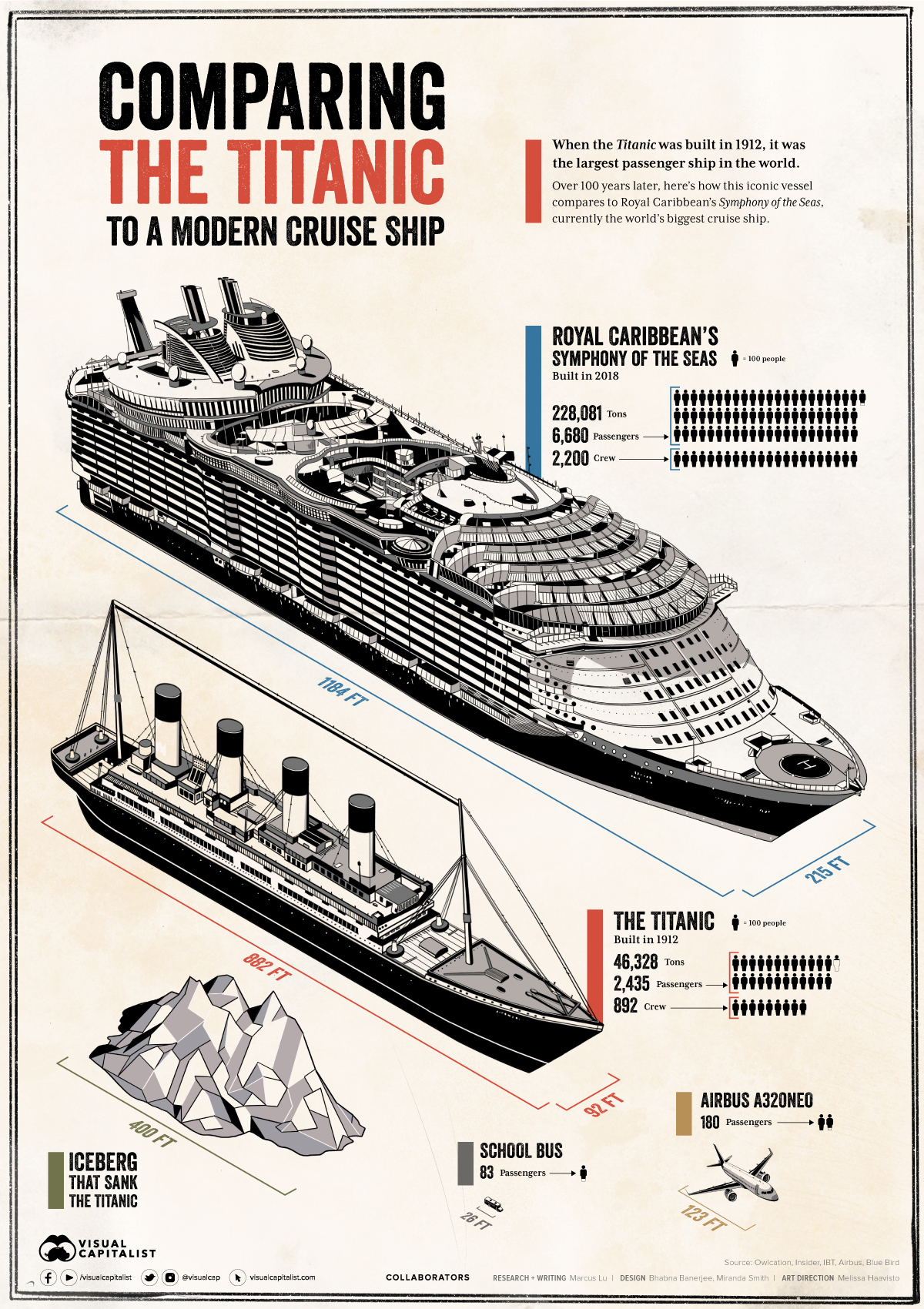
Modern cruising allows passengers to explore multiple destinations in comfort and style, a concept that was largely unimaginable in the era of the Titanic. The most famous passenger ship of all time is a title that still belongs to the Titanic, more than a century after its maiden voyage in 1912. Unfortunately, it’s because the sinking of the Titanic is still one of the worst maritime disasters in history, immortalized forever in museums, books, film and pop culture. In terms of passenger capacity, Icon of the Seas can carry over three times the number, and it has almost 2.5 times the number of crew working the ship. The best way to compare the two ships is in gross tonnage, as this tells you the overall volume of the ships.
This evolution reflects broader changes in society and travel preferences over the past century. As I’ve covered, a lot of modern cruise ships aren’t built to be the biggest but instead target a particular market. And sometimes, they’re built to certain dimensions to be able to sail to a specific destination.
It would be natural to assume that modern cruise ships would all be larger than the Titanic, since they’re all around a century newer. The average of modern cruise ships is definitely weighted lower by these speciality exploration and luxury ships, but remember that there are many ships that are longer than the Titanic was too. The Titanic’s gross tonnage was 46,328 while the average ship in today’s world would have a gross tonnage of around 77,000. So the Titanic was around 40% smaller than your average cruise ship today.
Additionally, there was a smoking room exclusively for men, and around three sittings of 470 people were possible in the dining room for third-class passengers. In addition to these amenities, first-class passengers had access to a smoking room, veranda cafes, a dining saloon, a restaurant, and a room to write and read. There were also squash courts, a gym, and a swimming pool for more active passengers. On the Titanic, first-class passengers were treated to the highest level of luxury available at the time.
It highlights that even though Carnival’s ships are generally smaller than Royal Caribbean’s, the disparity in gross tonnage with the Titanic is still remarkably large. Firstly, it’s important to clarify that gross tonnage does not reflect the weight of the ship. Cruise Hive was established back in 2008 and among the earliest blogs in the industry.
The restaurant is one of the earliest examples of extra-cost dining on a cruise ship. It was smaller than the main dining room but styled with elegant French decor. Modern cruise ships have around 15 decks, with 13 accessible to passengers. That’s because modern ships still need to be able to dock in older ports that don’t receive frequent upgrades and expansions.




No comments:
Post a Comment